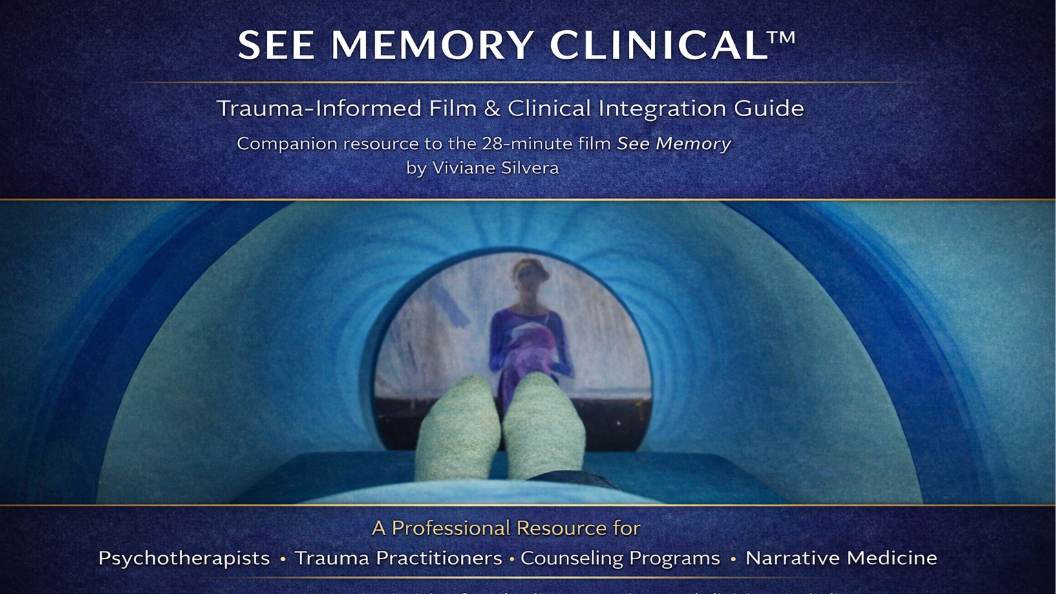
SEE MEMORY CLINICAL
A neuroscience-informed film and clinical toolkit for trauma therapy, clinician training, and reflective practice.
Developed by Viviane Silvera, MFA
(B.A. Psychology, Tufts University) • Founder, On Art LLC
See Memory Clinical™ combines the 28-minute PBS edition of the film with a clinical toolkit designed for therapists, educators, and training programs exploring trauma, emotional memory, and narrative healing.
Through a blend of visual storytelling and contemporary neuroscience, the film offers clinicians and patients a vivid way to reflect on how memories are carried, revisited, and understood within the therapeutic process.
Professional use of the film—including excerpts in therapy sessions, group settings, trainings, or screenings—requires a See Memory Clinical™ license.
See Memory also resonates strongly within psychoanalytic and depth-oriented traditions, where imagery, narrative, and symbolic expression are understood as pathways into emotional memory. Many clinicians find that the film’s visual language helps patients approach experiences that are difficult to articulate directly, allowing memory and meaning to emerge gradually through reflection and dialogue.
Developed by Viviane Silvera, MFA (B.A. Psychology, Tufts University) • Founder, On Art LLC
For professional/clinical use, excerpts, groups, or trainings, a clinical license is required.
See Memory has been presented in clinical, academic, and medical settings and is used by therapists, educators, and researchers exploring trauma, memory, and healing.
What is See Memory Clinical?
See Memory Clinical™ is a licensed professional resource built around the 28-minute PBS edition of See Memory and an accompanying facilitation framework for therapeutic and clinical settings.
Clinicians across psychotherapy, psychiatry, social work, and counseling have begun integrating the film into therapeutic conversations about trauma, emotional memory, and meaning-making.
The film supports conversation about trauma, memory reconsolidation, dissociation, and resilience through imagery that reaches patients in a different register than talk alone.See Memory Clinical™ has been adopted in clinical, academic, and medical settings and is used by therapists, educators, and researchers exploring trauma, memory, and healing.
The film has been screened and discussed in clinical, academic, and medical settings including psychotherapy communities, university programs, and neuroscience research environments.
What Clinicians Are Saying
“A powerful and accessible film for clinicians working with trauma and implicit memory.”
— Penny Rosen, LCSW
Chair, Program Committee
National Psychological Association for Psychoanalysis
“The visuals bypass defense. You drop into the psyche through this sensory, imaginal experience.”
— Joseph Lee, MSW
Jungian Analyst
This Jungian Life
“It’s like a meditation… it allows the unconscious to meet the image in its own time.”
— Deborah Stewart, LCSW
Jungian Analyst
This Jungian Life
“The response has been outstanding. I began using excerpts as an augmentation tool in psychotherapy with patients who have experienced trauma.”
— Dr. Silvana Riggio
Neurologist & Psychiatrist
Icahn School of Medicine at Mount Sinai
Common clinical applications
Individual therapy: imagery as a bridge into difficult memory content
Group therapy: shared viewing + structured reflection
Clinician training: trauma-informed discussion and case resonance
Psychoeducation: memory systems + emotional salience in accessible form
Hospital / clinic programming: wellness, narrative medicine, interdisciplinary dialogue
Community partner events: co-presented screenings with Q&A (licensed)
Depth-oriented therapy: exploring symbolic imagery, narrative identity, and emotional memory
Use in Training and Educational Settings
See Memory is also used in graduate training programs, residency seminars, and university counseling centers as a reflective teaching tool. The film’s visual exploration of emotional memory, trauma, and narrative identity can support discussions about how memory is experienced by patients and how clinicians listen to and work with these experiences in practice. Training programs often pair short excerpts from the film with facilitated discussion about therapeutic listening, trauma-informed care, and the role of narrative in clinical work.
Clinical Toolkit Included With License
Each clinical license includes access to the See Memory Clinical Toolkit, designed to help therapists integrate the film into individual sessions, group work, and clinician training.
The toolkit includes:
Session Framework
• Using See Memory in a Therapy Session (5-step method)
• Suggested clip segments for therapeutic use
• Facilitation prompts for discussion and reflection
Client Reflection Worksheets
• Memory Mapping Exercise
• Emotional Memory Reflection
• Imagery & Meaning Worksheet
• Rewriting the Scene Exercise
Discussion Prompts
• Questions for individual therapy sessions
• Group therapy reflection prompts
• Clinician training discussion prompts
These materials allow clinicians to integrate the film immediately into therapeutic work without needing to design their own framework.
How Clinicians Are Using See Memory
Clinicians report integrating the film in several ways:
• Showing short clips to introduce concepts like implicit memory or emotional memory
• Using imagery to help patients describe experiences that are difficult to verbalize
• Pairing the film with reflective worksheets during therapy sessions
• Facilitating discussion in trauma recovery groups
• Using the film in clinician training programs exploring trauma and memory
Because the film combines visual storytelling with neuroscience, many clinicians report that it helps patients understand trauma responses in ways that feel less abstract than traditional psychoeducation.
What Your See Memory Clinical License Includes
✔ Licensed access to the 30-minute PBS edition
✔ Permission for therapeutic and professional use (based on license tier)
✔ Access to the See Memory Clinical Toolkit
✔ Short film clips for session use
✔ Facilitation prompts and worksheets
✔ Optional live discussion with filmmaker Viviane Silvera
Licenses are structured to support ethical clinical use and protect the integrity of the work.
CLINICAL LICENSING OPTIONS
Individual Clinician
Most clinicians begin here
For solo practitioners.
Includes clinical use in individual sessions + in-practice viewing.
Includes:
• Streaming access to the 30-minute PBS edition
• Clinical toolkit with worksheets and facilitation prompts
• Use of short clips during individual therapy sessions
Designed for independent clinicians. Institutional and hospital licenses are available separately.
Small Practice
For 3–7 clinicians.
Includes multi-user access + internal training permission.
Mid-Size Practice
For 8–20 clinicians.
Includes multi-user access + internal training permission.
Medical Education & Residency Programs
For residency programs, fellowship training, and medical school departments using See Memory in resident education and clinical skills training.
Includes:
28-minute PBS edition (streaming access)
Clinical toolkit with therapeutic frameworks
Educational discussion guide (113 pages)
Short clips for teaching sessions
3-year departmental license
Optional facilitated Zoom session with filmmaker
Common settings:
Psychiatry, neurology, and family medicine residencies
Medical school narrative medicine programs
Fellowship training programs
Graduate programs in psychology, social work, counseling
From $1,495.00
Multi-department and campus-wide licenses available
Institutional & Clinical Program Partnerships
For hospitals, university counseling centers, residency programs, and multi-site treatment organizations interested in integrating See Memory Clinical™ into training, clinical discussion, or interdisciplinary programming.
Institutional licenses support the use of the film in clinical education, staff development, and programmatic conversations about trauma, memory, and therapeutic listening.
Many programs use the film as a starting point for discussion about emotional memory, narrative identity, and the experience of trauma from both clinical and patient perspectives.
Institutional licenses may include
• Campus or site-wide streaming access
• Use in clinical training programs and seminars
• Integration into educational curricula or supervision groups
• Staff training and professional development events
• Facilitated screenings followed by clinical discussion
• Optional implementation consultation with the filmmaker
Common institutional settings
• Hospital psychiatry and psychotherapy programs
• University counseling centers
• Graduate training programs in psychology and social work
• Residency and fellowship programs
• Narrative medicine and interdisciplinary health programs
Licensing
Institutional licenses are customized depending on the scope of use, number of clinicians or trainees, and whether programming or facilitated discussion is included.
Institutional licensing begins at $6,000.
Organizations interested in integrating See Memory Clinical™ into training or clinical programming are encouraged to reach out to discuss the most appropriate license structure.
Request Institutional Proposal
Not sure which tier fits? Send a note—we will guide you to the right license.
What Happens After You Purchase
Once your license is activated, you will receive access to the See Memory Clinical Portal, which includes:
• Streaming access to the 28-minute PBS edition of See Memory
• A library of short therapeutic clips that can be integrated into sessions
• The See Memory Clinical Toolkit, including session frameworks, reflection prompts, and client worksheets
• Guidance on using the film in individual therapy, groups, and clinician training settings
Access is provided shortly after purchase, allowing clinicians to begin exploring the materials and integrating them into practice.
Licenses are issued for a defined term (typically 1 year or 3 years) and can be renewed for continued access.
Ethical Use in Clinical Settings
See Memory Clinical™ is designed to support reflection, conversation, and psychoeducation within therapeutic contexts. It is not intended to replace clinical judgment or established treatment methods.
Clinicians are encouraged to integrate the film in ways that are appropriate to their professional training, client population, and therapeutic approach.
Because the film touches on themes related to trauma and emotional memory, therapists should exercise clinical discretion regarding when and how excerpts are introduced.
When used thoughtfully, many clinicians find that the film’s imagery can help patients explore experiences that are difficult to articulate through words alone.
See Memory has been presented in clinical, academic, and medical settings and has been used in conversations with neuroscientists, psychiatrists, therapists, and educators exploring trauma and emotional memory.
See Memory Clinical™ is intended for licensed professionals and supervised clinical trainees.
FAQ
See Memory Clinical™ is licensed for a defined term (1-year or 3-year). Continued access requires renewal of the license.
Your See Memory Clinical™ license is valid for use by the licensed clinician(s) within your practice. Access credentials may not be shared with individuals outside the licensed users.
Multi-clinician practices should select the appropriate Practice License.
Q: Can I use the PBS link in my practice?
A: The PBS link is for personal viewing only. Clinical, group, training, or public use requires a See Memory Clinical license.
Q: Can I show clips?
A: Clip use can be included depending on your license tier. Tell us your intended use and we’ll recommend the best fit.
Q: Can we host a screening with a discussion?
A: Yes—screening + facilitated discussion options are available for partner organizations and professional communities.
Q: Do you offer annual subscriptions?
A: Yes—annual options are available for clinicians and practices who prefer a lower barrier to entry.
Bring See Memory into your clinical work—with the right permissions.
Tell us your setting (solo practice, group practice, hospital/clinic, training program) and how you’d like to use the film. We’ll reply with the recommended license and next steps.